Fastco Fundamentals: The ABC's of Cold Heading
Exploring the Unique Advantages, Forming Differences, and Real-World Uses
In 2026, cold heading is one of the most efficient and precise metal forming processes used in manufacturing. While steel dominates most cold heading applications, more non-ferrous metals like aluminum, brass, and copper offer many unique advantages that can make them essential for specialized applications across automotive, aerospace, industrial, and other industries. While these aren't your typical cold heading materials, at times they can be the key to maximizing productivity, tool life, and part performance.
So the question lies, why does cold heading work so well with aluminum, brass, and copper? There are several traits that make them particularly well suited for cold forming.
High Ductility: Allowing the material to form without cracking under high pressures
Lower Yield Strength: Reduces forming forces and machine wear and tear
Excellent Surface Finish: Eliminates and reduces secondary machining
Superior Conductivity and Corrosion Resistance: Enables performance in harsh environments
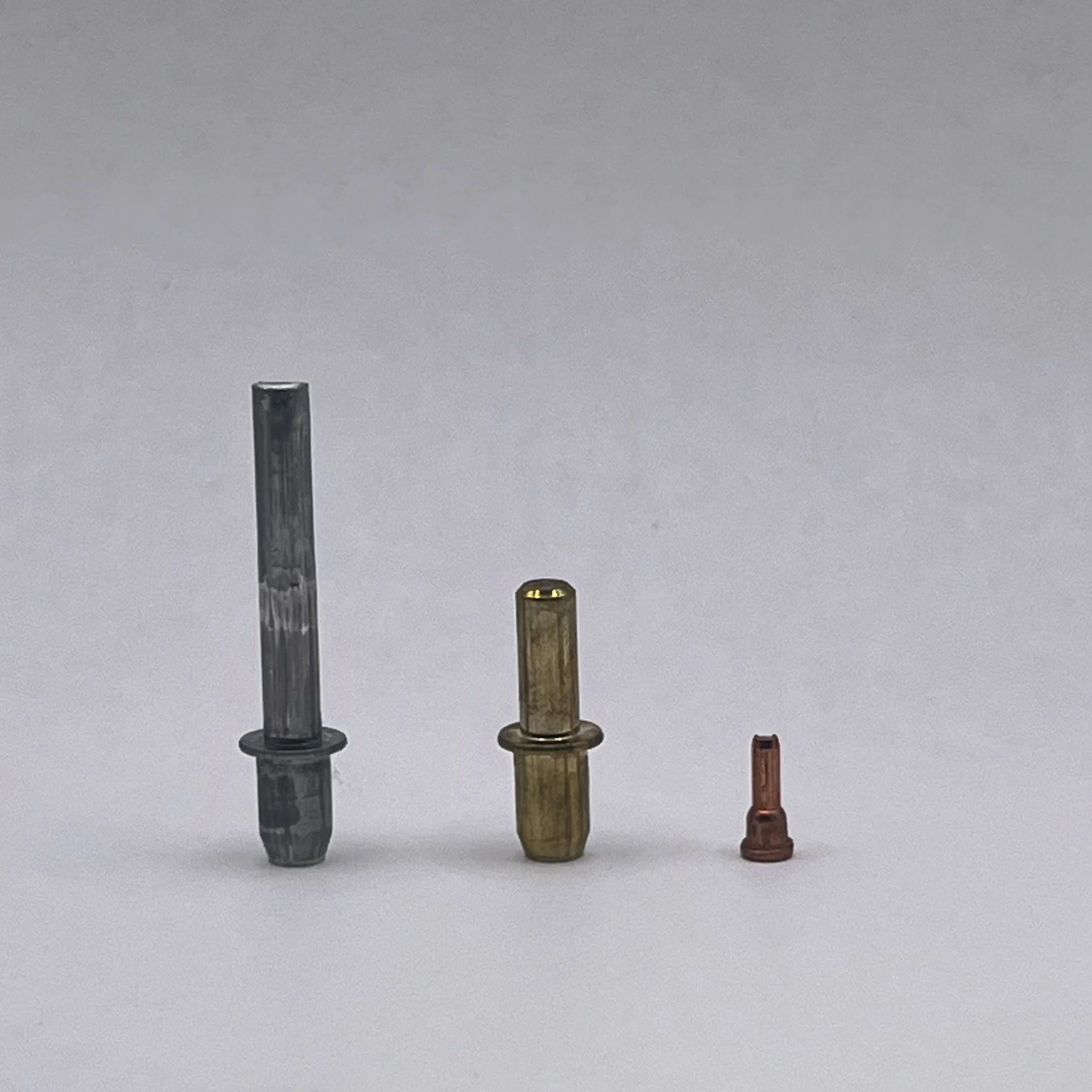
Each of these materials behaves differently under pressure, which can affect die design and process parameters.
Aluminum: Lightweight and High Production Speeds
Aluminums low density and superb formability makes it one of the easiest metals to cold head. Manufacturers can benefit from reduced forming loads, faster cycle times, and extended tool life. These kinds of fasteners are widely used in automotive lightweighting and aerospace assemblies, where every gram matters and every gram saved contributes to overall efficiency and performance.
Compared to brass and copper, aluminum requires lower forming forces, which enables higher stroke rates. It is more prone to galling and die pickup, requiring coatings and lubricants and more springback that needs compensation in die design. Because aluminum hardens less than copper, it can be cold headed into long or thin walled shapes without immediate annealing.
Brass: Strength, Machinability and Corrosion Resistance
Brass is one of the most widely used non-ferrous alloys in cold heading due to its balanced combination of formability and mechanical strength.
Some key performance advantages with this material include that workability under cold heading circumstances and good strength retention. Brass has excellent corrosion resistance in water and mild chemical environments and outstanding machinability for secondary operations. These characteristics make brass ideal for electrical connectors and precision fasteners. When being cold formed brass exhibits its strengths through stable material flow with minimal springback. A reduced risk of galling relative to aluminum and the ability to be formed into complex geometries, such as knurled inserts and multi-diameter fasteners without excessive forming stages.
Copper: Superior Conductivity and Deep Forming Capability
Copper is unique from aluminum and brass due to its unmatched electrical and thermal conductivity. As the material is much softer than brass, copper can be more challenging to form consistently because of its rapid work hardening.
It has one of the highest electrical conductivity of common engineering metals and outstanding thermal conductivity for heat dissipation along with high ductility. This enables extreme deformation without fractures in the material. Through its cold heading process the material flow is smooth, but highly sensitive to lubrication conditions. The copper hardens rapidly, increasing forming forces in later stages although intermediate annealing may be required for complex geometries. Because of its softness it often means that dies must be carefully polished to avoid surface marking, especially in electrical applications where surface finish directly impacts performance.
The ABC's within Industry Trends
Several manufacturing trends are accelerating the use of the ABC's in today's cold headed components. The rapid acceleration of electric vehicles and the increasing demand for copper connectors and terminals. Lightweighting initiatives, which are pushing aluminum to the forefront of more structural roles. Lead free and corrosion resistant plumbing regulations which are currently sustaining brass demand. As sustainability and material efficiency become more important, the ABC's of cold heading provide a low waste, high precision alternative to machining.
Each one of these materials offers distinct advantages in many different industries and in cold heading applications. Manufactures who can notice and understand these differences can optimize their processes, reduce tooling costs, and produce components that meet demanding functional and environmental requirements.
Understanding these forming differences is key to selecting the right material for both manufacturing efficiency and end-use performance. Aluminum supports high-volume lightweight production, brass provides dimensional stability and machinability, and copper delivers unmatched conductivity. By aligning material choice with application requirements and tooling considerations, manufacturers can fully leverage the performance edge that non-ferrous metals bring to cold heading processes.
Contact Fastco Industries today for expert guidance on selecting the ideal material for your cold-headed fastener needs.