Fastco Fundamentals: The Materials of Cold Heading: Carbon vs Stainless Steel
In the cold heading industry, success is measured by the precision of the "upset." The process of transforming a coil of wire into a high-performance fastener involves immense pressure, sophisticated tooling, and a deep understanding of metallurgy. Before a single blow is struck, the most critical decision has already been made: The Material.
At Fastco Industries, we know that selecting the right grade isn’t just about the end use; it’s about how that metal flows under pressure and what happens to it after it leaves the machine.
1. Formability: The "Station Count" Reality
The complexity of your fastener and the material grade determine how many "hits" or stations are required.
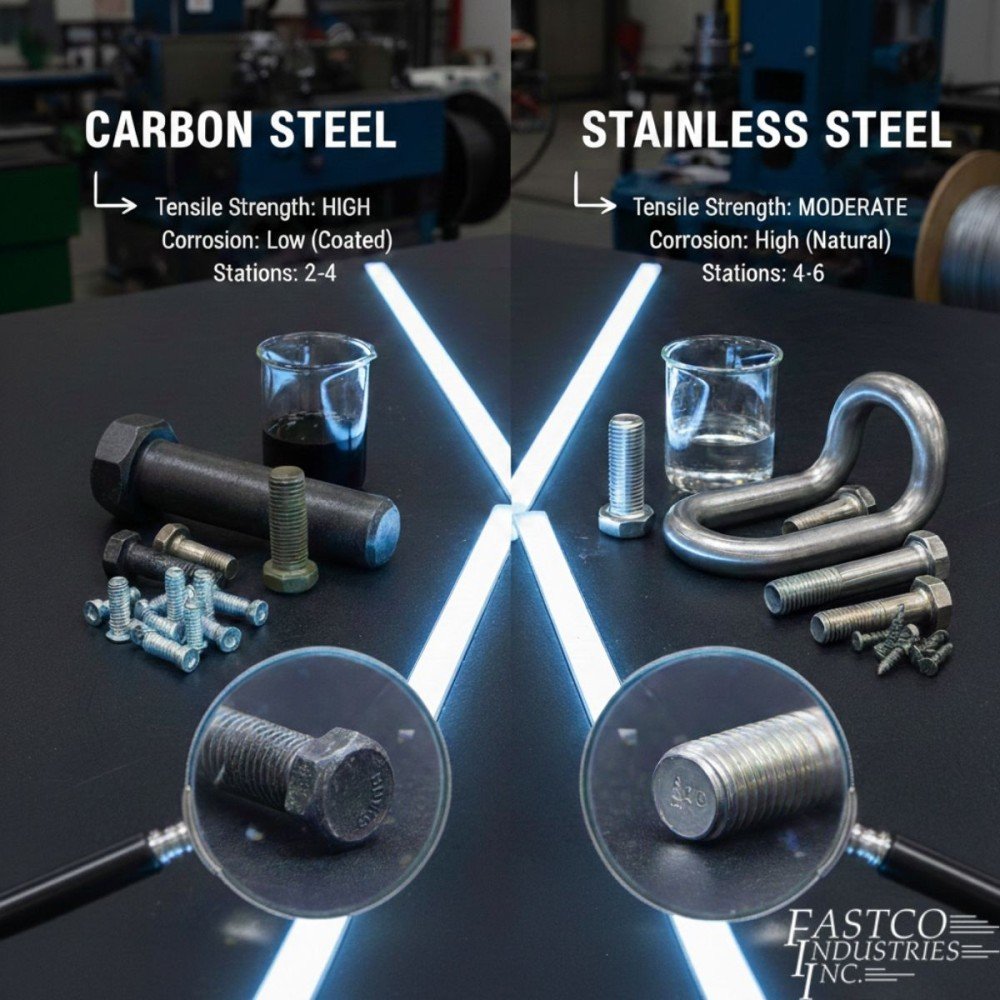
Carbon Steels (1010, 1022, 10B21, 1541): These are the workhorses of high-speed production. Because they are highly ductile, they flow easily into die cavities. Most standard carbon fasteners can be completed in 2 to 3 stations, resulting in faster cycle times and significantly longer tool life.
Stainless Steels (304, 316, 410, 431): Stainless is notorious for work-hardening. The moment the wire is struck, it gains internal strength and resistance. To move this "stubborn" metal without cracking the head or the punch, you often need 4 to 5 stations (at Fastco, we can do up to 6 stations!). This gradual shaping protects the integrity of the grain flow but requires more complex machinery.
2. Tensile Strength and Heat Treatment
How a fastener achieves its final "muscle" depends entirely on its chemistry.
The Quench & Temper Group
10B21 & 1541: These are designed for heat treatment. 10B21 (Boron-treated) is a favorite for achieving Grade 5 or Grade 8 strength (up to 150,000 psi) with high reliability. 1541 (Manganese-rich) is used for heavy-duty applications like wheel bolts that demand high hardenability.
410 & 431 Stainless: Unlike common stainless, these are Martensitic. They can be quenched and tempered to achieve high hardness, making them perfect for self-drilling screws that must be hard enough to tap through metal while resisting rust.
The Cold-Work Group
304 & 316 Stainless: These cannot be hardened by heat. Their final tensile strength is determined by the cold-working performed during the heading process itself. While they offer excellent toughness, they won't reach the extreme Rockwell C hardness of a heat-treated 10B21 bolt.
3. Corrosion Strategy: Coatings vs. Natural Resistance
One of the biggest divides in the shop is how the part is protected from the elements.
Carbon Steel: Grades like 1010, 1022, and 10B21 have no natural defense against oxidation. To prevent rust, they must undergo secondary coating processes such as Zinc Plating, Hot-Dip Galvanizing, or specialized Geomet/Magni coatings. While the wire is cheaper, these extra steps add lead time and the risk of hydrogen embrittlement.
Stainless Steel: The 300 and 400 series contain Chromium (and Molybdenum in 316), which forms a self-healing oxide layer. Stainless does not require secondary coatings. This eliminates the plating line entirely, making it the preferred choice for medical, marine, and food-grade applications where "bare" metal is a requirement.
Choosing between the high-speed efficiency of a 10B21 carbon steel and the rugged, coat-free durability of 304 or 316 stainless requires more than just a spec sheet, but it requires a manufacturing partner who understands the floor-level reality of cold heading.
Whether you are looking to start a new job or optimize an existing part, our team is ready to help you balance tensile strength, station count, and total cost.
Contact Fastco Industries today for expert guidance on selecting the ideal material for your cold-headed fastener needs.